
Both sides have now revealed a preference for escalation over strategic defeat, and each new provocation narrows the space for the next pause. The Touska seizure, Iran's refusal to negotiate under blockade, Israel's strikes on Iranian oil infrastructure -- all of these add up to an increasingly untenable situation. This makes the wild card -- Trump and his motormouth -- more consequential than ever, notes Prem Panicker in his must read blog on the Iran War.

Amidst escalating tensions in West Asia, Russian President Vladimir Putin is actively calling for de-escalation and political resolution, engaging with Iranian and US counterparts to navigate the complex conflict landscape.

Donald Trump has escalated his public feud with Pope Leo XIV, criticising the Pontiff's stance on Iran's nuclear ambitions and domestic issues, while the Pope maintains his focus on spiritual advocacy and global peace.

If Trump doesn't like India, that is his choice. But to use such distasteful language on a public platform is deeply offensive and needs to be called out, points out Amberish K Diwanji.

'Much will depend on the position of the United States.' 'It will have to be seen to what extent the US will be more interested in achieving some form of a deal and to what extent Israel will be allowed to continue to carry out both airstrikes and the killing of Iranian officials.'

'The next two to three weeks will not be decided in Washington.' 'They will be decided in Tehran, in whatever calculation Iran makes about the costs of continued resistance against the costs of appearing to have yielded.'

The ceasefire is still technically holding, to the extent that no overt hostilities have been reported yet, but the rhetoric has hardened dangerously. The week ahead will also clarify whether the Islamabad failure was a negotiating tactic or whether Washington has genuinely locked itself into a position from which the only exits are climb-down, escalation, or the slow bleed of a new status quo that nobody chose and nobody controls. Prem Panicker continues his must read blog on the Iran War.

'What we have yet to see on either the US or the Iranian side is willingness to compromise on their ultimate demands and the flexibility to reach an agreement to end the war.

India has expressed strong concerns over attacks on commercial ships in the Strait of Hormuz, citing its importance to India's energy and economic security. Ambassador Yojna Patel highlighted the need to respect international law and ensure the safety of seafarers, while also addressing broader Middle East issues including the situation in Gaza and Lebanon.

Karex, the Malaysian company that makes roughly one in five of the world's condoms -- about five billion a year, supplying Durex and Trojan among others -- announced this week that it is raising prices by up to 30 percent. The reason is the Strait of Hormuz.

Equipped with advanced weaponry, the HMS Anson is fitted with "Tomahawk Block IV land-attack missiles" with a range of 1,600 km and "Spearfish heavyweight torpedoes," providing formidable offensive capabilities.

The US President clarified that these negotiations do not involve the new Supreme Leader, Mojtaba Khamenei.

He also criticised the possible succession of the son of the late supreme leader of the Islamic Republic, Mojtaba Khamenei, who is widely viewed as a leading contender for the position.

The West Asia conflict escalated sharply as Iran launched missiles towards Israel, while Tehran confirmed the killing of its intelligence minister in Israeli strikes, marking the third assassination of a senior Iranian official in two days.

If Trump wants peace with Iran, Pakistan will offer to help. If Trump seeks Pakistan's aid to spy on Iran, then too Munir will not hesitate to chip in. At the same time, the ISI will not hesitate to tip off Iran now and then, points out M R Narayan Swamy.

Chinese President Xi Jinping warned US President Donald Trump that mishandling the Taiwan issue could trigger conflicts between the two countries during wide-ranging talks on trade, Iran, and energy security.

Following a US agreement to a ceasefire, Iran claims victory and outlines conditions for a lasting peace deal, including control over the Strait of Hormuz and the removal of sanctions.

As Iran heads into crucial peace talks with the United States of America, here are the six men who decide the Islamic Republic's course.

FIFA President Gianni Infantino says the 2026 World Cup will proceed as scheduled despite uncertainty over Iran's participation due to security and geopolitical tensions.
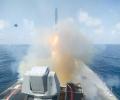
'India was not obliged to protect the Iranian ship.' 'Once the Iranian ship left Indian waters, she was on her own.' 'Guilt tripping India is wrong.'

Iran's football federation is in discussions with FIFA about moving their World Cup matches from the United States to Mexico due to concerns about the safety of their players, Iranian football president Mehdi Taj said.
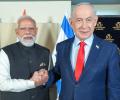
The Congress party has criticised the Indian government's diplomatic strategy, claiming a 'severe setback' if reports of Pakistan mediating between the US-Israel and Iran are accurate. The party alleges Pakistan's diplomatic engagement has surpassed India's, despite military successes.

The Israeli military said the strike dismantled the bunker during ongoing operations against Iranian military infrastructure.

One of the most uncivilised characteristics of this war has been the total disregard for international law and the laws of armed conflict, asserts Vice Admiral Biswajit Dasgupta (retd).

...reopen for up to six months. Until then, the Strait stays nearly closed. The world pays. And no one, including the man who started this, can say when it ends, notes Prem Panicker in his must read blog on the Iran War.

China has criticised the US blockade of the Strait of Hormuz, calling it a dangerous and irresponsible move, and urged Washington and Tehran to honour the ceasefire. Beijing also denied aiding Iran militarily and threatened countermeasures if the US imposes tariffs.

India has expressed condolences over the death of Iran's Supreme Leader Ayatollah Ali Khamenei following a joint US-Israel strike, amidst rising tensions in West Asia and criticism over the sinking of an Iranian warship.

The core issues to be settled -- access to Hormuz, Israel's aggression in Lebanon, the question of Iran's nuclear programme, sanctions relief and compensation -- are thorny enough to require weeks of patient negotiation. The most likely outcome of the opening sessions is that both sides take the measure of each other, establish what is and is not negotiable, and return home without having broken anything. That would count as progress.
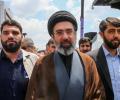
'Mojtaba Khamenei supervised the most recent repression in December 2025 and January 2026 which remains ongoing.'

'US and Iran have not annulled the ceasefire, and the possibility of continuing negotiations remains open.'

India-based Iranian actresses Mandana Karimi and Elnaz Norouzi share their deep concerns and anxieties about the escalating crisis in Iran, and reveal the personal toll on their lives and the Iranian diaspora.

The delegations from the US and Iran head to Islamabad on Friday, carrying a ceasefire that is already fraying, a Strait that is technically open and practically closed, and a negotiating agenda that would challenge even parties actually negotiating in good faith, which these groups are not. Prem Panicker continues his must read blog on the Iran War.

Russian President Vladimir Putin is actively working to de-escalate the escalating crisis in the Gulf, engaging with regional leaders following Iran's retaliatory strikes on US facilities after joint US-Israeli strikes against Iran.

United States President Donald Trump on Friday declared that there would be 'no deal with Iran except unconditional surrender' amid the escalating West Asia conflict, asserting that Tehran must capitulate before any diplomatic negotiations can proceed.
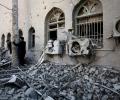
The logic of war plus the gathering storms in US politics as the midterms loom large leave him with no real alternative but to negotiate, points out Ambassador M K Bhadrakumar.
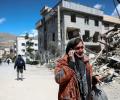
Fleur Hassan-Nahoum, special envoy, foreign ministry of Israel, has asserted that the situation has effectively been a "multi-front regional conflict" since its inception, while claiming significant military and strategic gains against adversarial forces.

'Despite the large number of missiles and drones we have already launched, we still possess reserves and missile cities whose doors have not yet been opened,' says Iran's Consul-General Saeid Reza Mosayeb Motlagh.

Amidst ongoing conflict, Iranian President Masoud Pezeshkian signals a potential de-escalation by apologising to neighbouring countries while firmly rejecting US President Donald Trump's demand for unconditional surrender.

'As result, Netanyahu 'convinced' Trump to go to war with the help of overoptimistic Israeli intelligence assessments, essentially explaining to him that they only need to bomb Iran for 3-4 days, and the regime would then collapse.' 'Rather unsurprisingly, Netanyahu is ever since blaming his own intel service for the entire operation failing.'

The question is no longer whether the war will expand. It has. The next few days will tell us whether the war stabilises around Hormuz or whether the Strait itself becomes the trigger for a far larger rupture. What to watch for over the next 48 hours is simple: Any move by the US toward direct naval control of the Strait; any credible Iranian attempt to disrupt or mine shipping lanes and, critically, whether energy infrastructure in the Gulf continues to be targeted.If those lines are crossed in tandem, the war will no longer be containable within the region.
